Get cardiac answers when you need them. Butterfly it.
TTE, flow assessment and biplane valve views in your pocket.


We’ve joined forces with the American College of Cardiology to support innovative cardiovascular care.
Learn more

Built for fast TTE.
Perform focused bedside TTE fast with handheld cardiac coherence imaging. Rule out pericardial effusion with the support of 1-touch image optimization.
Assess flows and murmurs. Evaluate suspected valve disease.
Help identify peripheral arterial disease, carotid stenosis, and acute vascular abnormalities with Pulsed-Wave Doppler. Assess fluid status and flow profile at the point of care.


See the heart in two planes simultaneously.
Biplane imaging in your pocket, to help you locate and assess cardiac anatomy more effectively.
Clinical evidence.
Detection of Early Cardiac Tamponade with Butterfly iQ+.
This case illustrates the ability of POCUS as a tool to help the clinician hasten intervention for potentially life-threatening conditions, in this case prompting urgent intervention with pericardiocentesis.
Point-of-care Ultrasound in Morbidity and Mortality Cases in Emergency Medicine: Who Benefits the Most?
POCUS was felt to have the potential to reduce or prevent M&M in 45% of cases in which it was not used. Cardiac and Lung POCUS were among the most useful applications, especially in patients with cardiopulmonary complaints and in those with abnormal vital signs.
Get started with Butterfly iQ+.
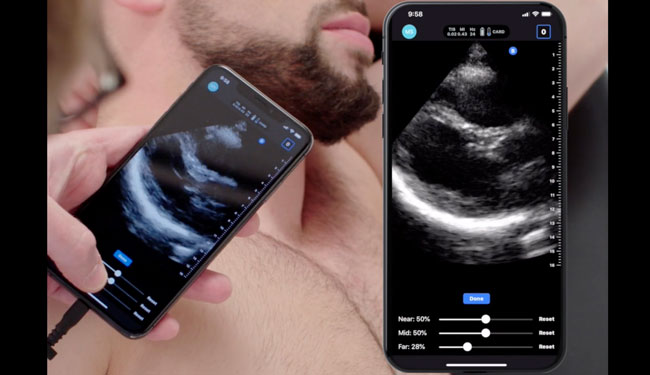

Learn how to obtain the parasternal long view.
Mastering the 4 basic views of the heart is the first step to perform focused cardiac assessment. Learn how to assess gross cardiac size, structure and function at the bedside with Dr. Mike Stone.

Learn basic scanning technique for lung.
An introduction to the basic scanning technique for lung ultrasound – useful in the differentiation of CHF and COPD.

Ultrasound in cardiac arrest.
How to incorporate ultrasound into the evaluation of a patient in cardiac arrest.
"These videos are for informational purposes only, to demonstrate potential uses of the Butterfly probe They are not a substitute for professional clinician training and experience. Clinicians are solely responsible for patient care and for exercising their independent clinical judgement at all times."
Dr. David Liang
An intimate discussion about the ways handheld ultrasound can support cardiology practice.


Frequently Asked Questions
How is ultrasound used in cardiology?

Ultrasound is the primary imaging modality in cardiology, used to evaluate heart structure and function including left and right ventricular function, valve morphology and regurgitation, pericardial effusion, and cardiac output. Handheld POCUS with Butterfly iQ3 is increasingly used by cardiologists and non-cardiologists alike for rapid focused cardiac assessment at the bedside, supplementing formal echocardiography in time-sensitive situations.
What is cardiac POCUS and how does it differ from formal echocardiography?
Cardiac POCUS is a focused, bedside ultrasound exam performed by the treating clinician to rapidly assess heart function and identify critical abnormalities — such as pericardial effusion, severe LV dysfunction, or right heart strain. It differs from formal echocardiography in scope and intent: formal echo is a comprehensive diagnostic study performed by a trained sonographer and interpreted by a cardiologist, while cardiac POCUS answers specific clinical questions in real time.
Can Butterfly iQ3 be used for cardiac exams?
Yes. Butterfly iQ3 supports parasternal, apical, subcostal, and suprasternal cardiac views used in focused cardiac assessment. It is FDA cleared for cardiac imaging and is used by emergency physicians, hospitalists, intensivists, and cardiologists for bedside cardiac evaluation. Advanced cardiac imaging for formal diagnostic echocardiography may require dedicated echo systems with higher-end transducers.
What are the benefits of handheld ultrasound in cardiology?
Handheld ultrasound with Butterfly iQ3 allows cardiologists and advanced practice providers to perform immediate cardiac assessment without scheduling a formal echo or waiting for a shared machine. Benefits include faster diagnosis of critical conditions like tamponade or acute LV failure, reduced reliance on auscultation alone, and the ability to perform serial assessments to monitor treatment response — all at the bedside.
Can Butterfly ultrasound detect pericardial effusion?
Yes. Detection of pericardial effusion is one of the most well-established and reliable cardiac POCUS applications. Butterfly iQ3 provides clear subcostal and parasternal views that allow clinicians to identify pericardial effusion and assess for signs of hemodynamic compromise such as right ventricular collapse — supporting urgent management decisions.
Is Butterfly iQ3 used in outpatient cardiology?
Yes. Butterfly iQ3 is used in outpatient cardiology clinics for rapid focused cardiac assessment during patient visits — enabling cardiologists to correlate physical exam findings with real-time imaging without sending patients for a separate echo appointment. This supports faster clinical decision-making and a more efficient patient experience.