

Join devRant
Do all the things like
++ or -- rants, post your own rants, comment on others' rants and build your customized dev avatar
Sign Up
Pipeless API
From the creators of devRant, Pipeless lets you power real-time personalized recommendations and activity feeds using a simple API
Learn More


 No questions asked
 As a Python user and the fucking unicode mess, this is sooooo mean!
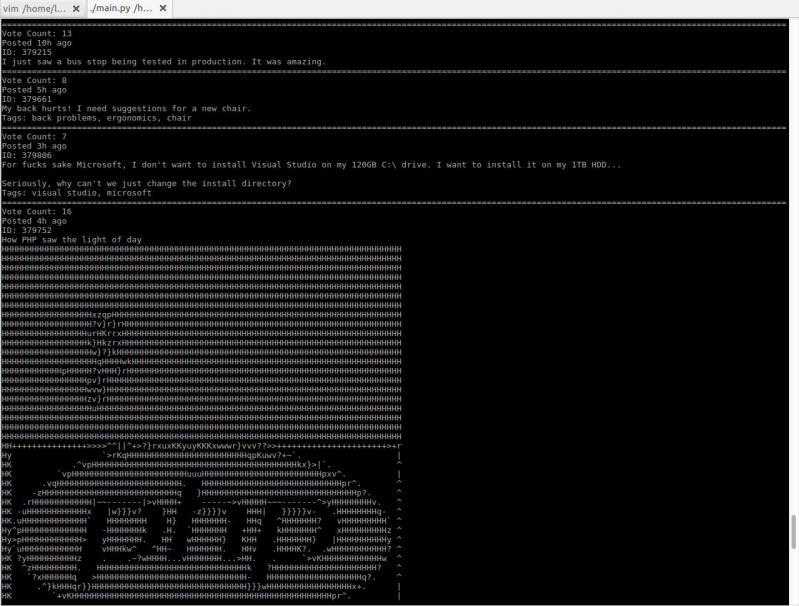 I just started working on a little project to browse devrant from terminal. It converts images to ascii art!
I have to create python parser (3.6) using code provided by client (2.7), that they used in their company, and it is full of crap like:
if a==1:
if not b:
c = [1,2,3]
if a==2:
if not b:
c = [1,2,3]
if b:
c = [1,2,4]
Or:
text = ""
for i in something:
text += "real text " + some_string + " \n"
text += "another line " + some_string + " \n"
text += "and another " + some_string + " \n"
text += "and so on " + some_string + " \n"
... (many lines instead of one appended text block)
Of course above variable names are just for shortening code, but there are variables like oo, ooo, var_ or var__... cause you know, PEP8 does not exist.
undefined
python
refactoring