Details
Joined devRant on 8/2/2016
Join devRant
Do all the things like
++ or -- rants, post your own rants, comment on others' rants and build your customized dev avatar
Sign Up
Pipeless API

From the creators of devRant, Pipeless lets you power real-time personalized recommendations and activity feeds using a simple API
Learn More
-
Fuck it I’m posting it again because I got got by this…Again.
If this is how you write your APIs, take a number, get in line. I got some slapping to get out of my system.
5 -
I haven't said anything yet, but an AltRant notification server exists. Support for it will arrive very very soon on the AltRant app. It will run locally on the end user's personal computer, and it does not require a constant connection to the phone. Both devices need to be connected to the same local network on first connection, but after that you can wander out of your house or disconnect from the local network and still receive notifications.
DISCLAIMER: ALL SENSITIVE USER CREDENTIALS ARE NOT STORED *ANYWHERE* EXCEPT ON THE LOCAL USER'S MACHINE. NO DATA IS SENT TO ME. THE SERVER IS OPEN-SOURCE, HAS NO RELEASE BINARIES AND RUNS ON PYTHON.
Note to @dfox: if you want this to not exist or not be supported inside AltRant, please tell me or send me an email about it.2 -
For the love of sex, can someone help me out??!!
There is a VS Code extension that helps in creating a step-by-step tutorial of a codebase. Can someone please tell me its name?!
Google is a bitch today.3 -
Can we agree, a lot of people tend to pick the wrong one for the job at hand.
And just in case devRant does it's magic on the image....
Full image
https://storage.googleapis.com/gweb...
12 -
Hey everyone,
During some backend improvements to the devRant infrastructure, some of our async queue processors (SQS) stopped working which caused many notifs to not go out/stop working. Unfortunately our alerting didn’t pick up on this since there were still queues being processed (just not specific ones) and some aspects of notifs working. Big apologies for this issue!
It is now resolved, and while very delayed, no notifications were lost and all were processed after the queue processors started up again. Sorry for the bulk notifs, but we wanted to make sure all that were supposed to go out went out.
Additional alerting will be put in place to prevent this from happening again.
Thanks for your patience!16 -
For years I worried I was not a good programmer because of bugs, issues and not giving accurate timescales.
Then I discovered devRant and realised that there’s thousands of us that have the same issues.16 -
I turned a 20 hour per month task into a 150ms database query.
I feel like a fucking super hero.
FYI my super hero name is ThreadPool (see past rant)4 -
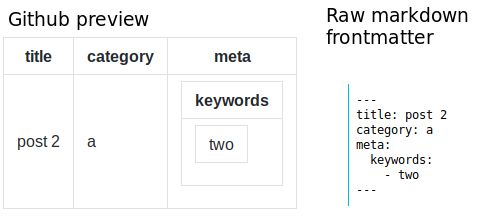
TIL Github renders markdown YAML frontmatter as nested markdown tables! Awesome as lightweight structured data documentation tool
1 -
I've optimised so many things in my time I can't remember most of them.
Most recently, something had to be the equivalent off `"literal" LIKE column` with a million rows to compare. It would take around a second average each literal to lookup for a service that needs to be high load and low latency. This isn't an easy case to optimise, many people would consider it impossible.
It took my a couple of hours to reverse engineer the data and implement a few hundred line implementation that would look it up in 1ms average with the worst possible case being very rare and not too distant from this.
In another case there was a lookup of arbitrary time spans that most people would not bother to cache because the input parameters are too short lived and variable to make a difference. I replaced the 50000+ line application acting as a middle man between the application and database with 500 lines of code that did the look up faster and was able to implement a reasonable caching strategy. This dropped resource consumption by a minimum of factor of ten at least. Misses were cheaper and it was able to cache most cases. It also involved modifying the client library in C to stop it unnecessarily wrapping primitives in objects to the high level language which was causing it to consume excessive amounts of memory when processing huge data streams.
Another system would download a huge data set for every point of sale constantly, then parse and apply it. It had to reflect changes quickly but would download the whole dataset each time containing hundreds of thousands of rows. I whipped up a system so that a single server (barring redundancy) would download it in a loop, parse it using C which was much faster than the traditional interpreted language, then use a custom data differential format, TCP data streaming protocol, binary serialisation and LZMA compression to pipe it down to points of sale. This protocol also used versioning for catchup and differential combination for additional reduction in size. It went from being 30 seconds to a few minutes behind to using able to keep up to with in a second of changes. It was also using so much bandwidth that it would reach the limit on ADSL connections then get throttled. I looked at the traffic stats after and it dropped from dozens of terabytes a month to around a gigabyte or so a month for several hundred machines. The drop in the graphs you'd think all the machines had been turned off as that's what it looked like. It could now happily run over GPRS or 56K.
I was working on a project with a lot of data and noticed these huge tables and horrible queries. The tables were all the results of queries. Someone wrote terrible SQL then to optimise it ran it in the background with all possible variable values then store the results of joins and aggregates into new tables. On top of those tables they wrote more SQL. I wrote some new queries and query generation that wiped out thousands of lines of code immediately and operated on the original tables taking things down from 30GB and rapidly climbing to a couple GB.
Another time a piece of mathematics had to generate all possible permutations and the existing solution was factorial. I worked out how to optimise it to run n*n which believe it or not made the world of difference. Went from hardly handling anything to handling anything thrown at it. It was nice trying to get people to "freeze the system now".
I build my own frontend systems (admittedly rushed) that do what angular/react/vue aim for but with higher (maximum) performance including an in memory data base to back the UI that had layered event driven indexes and could handle referential integrity (overlay on the database only revealing items with valid integrity) or reordering and reposition events very rapidly using a custom AVL tree. You could layer indexes over it (data inheritance) that could be partial and dynamic.
So many times have I optimised things on automatic just cleaning up code normally. Hundreds, thousands of optimisations. It's what makes my clock tick.4